I found an old productivity guide at work. It explains a lot about modern work.
About fifteen years ago, I found this printed productivity guide lying around at work. No author name. No branding. Just a stapled handout with the headline “How to Increase Your Productivity by 250% in One Week.”
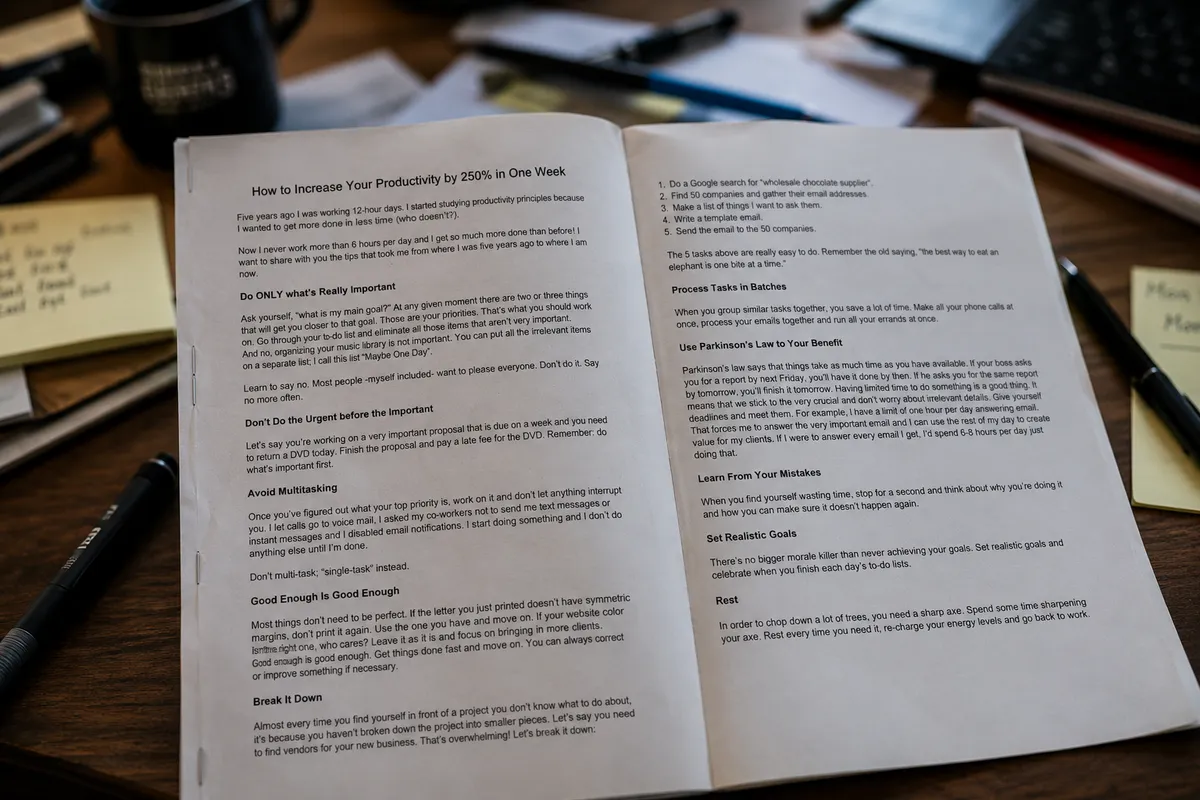
In hindsight, it captures a very particular moment in productivity culture.
I expected the advice inside to be completely outdated. Peak productivity-blog era stuff. Hustle culture before we really had a name for it. Rereading it recently turned out to be more interesting than expected.
Some parts felt dated immediately. Other parts held up surprisingly well. A few sections even hinted at problems that would become much more visible later.
The document talks about things like:
- focusing only on important tasks
- avoiding multitasking
- batching similar work together
- breaking large projects into smaller pieces
- limiting distractions
- resting properly
None of that sounds revolutionary now, which is partly the point.
These days I operate under the banner of The Gluttonous Sloth, so there was something mildly amusing about rediscovering old productivity advice that essentially argued for slower, more intentional work.
A decade later, the software looks different, but the underlying frustrations feel familiar.
One section argued that you should not do the urgent before the important. I suspect that matters more today than when this was written.
Modern organisations have become remarkably good at generating urgency. Messages arrive instantly, dashboards update continuously, and notifications compete for attention all day long.
The challenge is that urgency and importance are rarely the same thing. The easier communication becomes, the more discipline is required to distinguish between the two.
Modern work creates endless opportunities to feel productive without actually moving anything meaningful forward:
- notifications
- meetings
- Slack messages
- Teams chats
- dashboards
- email loops
- AI-generated busywork
A lot of modern work feels productive right up until you realise nothing important actually moved forward.
Another section warned against multitasking - a recommendation that aged remarkably well.
The modern workplace evolved in the exact opposite direction. Most people now work inside permanent interruption systems. Attention is fragmented by design. Anyone who has had a genuinely uninterrupted hour of work knows how rare and valuable it has become.
That part of the document held up extremely well.
Other parts did not.
The obsession with quantifying productivity feels dated now. The idea that every problem can be solved through personal optimisation and tighter self-discipline also feels incomplete.
Real work is messier than that.
In consulting, hospitality, leadership, operations, and client work, friction is not always a personal failure. Systems can be unclear, priorities can conflict, communication structures can break down, and people can simply become overloaded.
Older productivity culture often treated effectiveness as an individual responsibility.
In practice, people work differently depending on how the organisation itself operates.
There was also one section that stood out for a different reason.
It talked about rest.
The section was refreshingly straightforward. It simply argued that people need proper rest.
The framing was still productivity-oriented: rest so you can work better afterwards.
Even that feels surprisingly grounded compared to parts of modern productivity culture that somehow turned optimisation itself into a full-time job.
Looking back, the most useful parts of this old guide were not the productivity hacks.
They were the reminders that focus, attention, priorities, and rest still matter.
The tools became faster. The noise became louder. Human attention still moves at roughly the same speed it always did.
The older I get, the more I suspect the Sloth had the right idea all along.